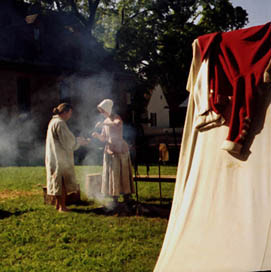
(Civilians with the Regiment)
Following The Troops . . .
(Civilians with the Regiment)
Under this category are the families of the soldiers and civilians (teamsters, tradesmen, etc) who were contracted by the unit.
Families: Although some officers were accompanied by their wives and children on campaign, most men in the ranks were discouraged from marrying, but many of them apparently made less official arrangements. According to regulations, they were allowed six women per company to be carried on the army’s ration rolls. Commanders of both armies tried to limit numbers of ‘unofficial’ camp followers because they and their children were fed (officially or not) from the supply wagons. There are also references to women and children encumbering baggage wagons and slowing the march of the army.
However, the presence of women had beneficial effects, as well. They sometimes served as nurses on campaign and also did more mundane work such as laundry, cooking and foraging. Their effect on morale was also important, if less empirical. There is at least one reference to a transport ship delaying its departure due to “mutinous behavior” of the men, demanding that their allowed quota of campfollowers be allowed on board.
 The
hardships, which these families endured, can not be fully imagined.
Like their husbands and fathers, these families traveled hundreds/thousands
of miles on foot – all the while suffering from malnutrition, lack of adequate
shelter, clothing and basic medical care. In friendly areas, they
could hope to find charity from the people. In those areas in arms
against King, they could hope for very little. In either community,
they found themselves being treated as the lowest in society. If
a soldier was among the refuse of society, what could those that followed
him possibly be?
The
hardships, which these families endured, can not be fully imagined.
Like their husbands and fathers, these families traveled hundreds/thousands
of miles on foot – all the while suffering from malnutrition, lack of adequate
shelter, clothing and basic medical care. In friendly areas, they
could hope to find charity from the people. In those areas in arms
against King, they could hope for very little. In either community,
they found themselves being treated as the lowest in society. If
a soldier was among the refuse of society, what could those that followed
him possibly be?
Other Civilians: A regiment was not self sufficient and required the skills and talents of those from without. Such manpower/skill shortages were overcome by contracting civilians for specific periods of time or projects. Typically, the regiment hired wagons and teamsters to carry the regimental stores. Carpenters masons, and smiths were hired to build shelter, fabricate equipment, maintain the regimental animals, etc., etc.