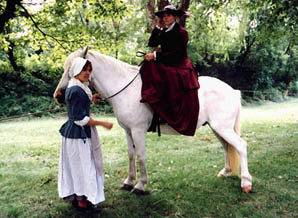
 It
is a common perception that women always rode sidesaddle up until the 20th
century, but this is an oversimplification. The reality is more complex
and involves the development of the sidesaddle itself.
It
is a common perception that women always rode sidesaddle up until the 20th
century, but this is an oversimplification. The reality is more complex
and involves the development of the sidesaddle itself.
It
is a common perception that women always rode sidesaddle up until the 20th
century, but this is an oversimplification. The reality is more complex
and involves the development of the sidesaddle itself.
A modern sidesaddle is distinguished by the presence of a ‘leaping horn’ and the ‘balance strap’. These modifications of sidesaddle design were developed in the mid to late 19th century. They are important because they allow the sidesaddle rider to move at speed (i.e., trot, canter, gallop) and to jump obstacles. Prior to these modifications, sidesaddles simply did not provide enough security to regularly perform any gait more challenging than a walk. Paintings of 18th century women riding sidesaddle uniformly show the horse walking or standing still and often held by a groom, or else the woman may be sedately riding pillion (seated sideways behind a man on the same horse). Does this mean that 18th century women never rode fast? No, but it does mean that women who rode fast did so astride. References exist to wealthy women who rode astride, including some European royalty (e.g., Marie Antoinette.)